














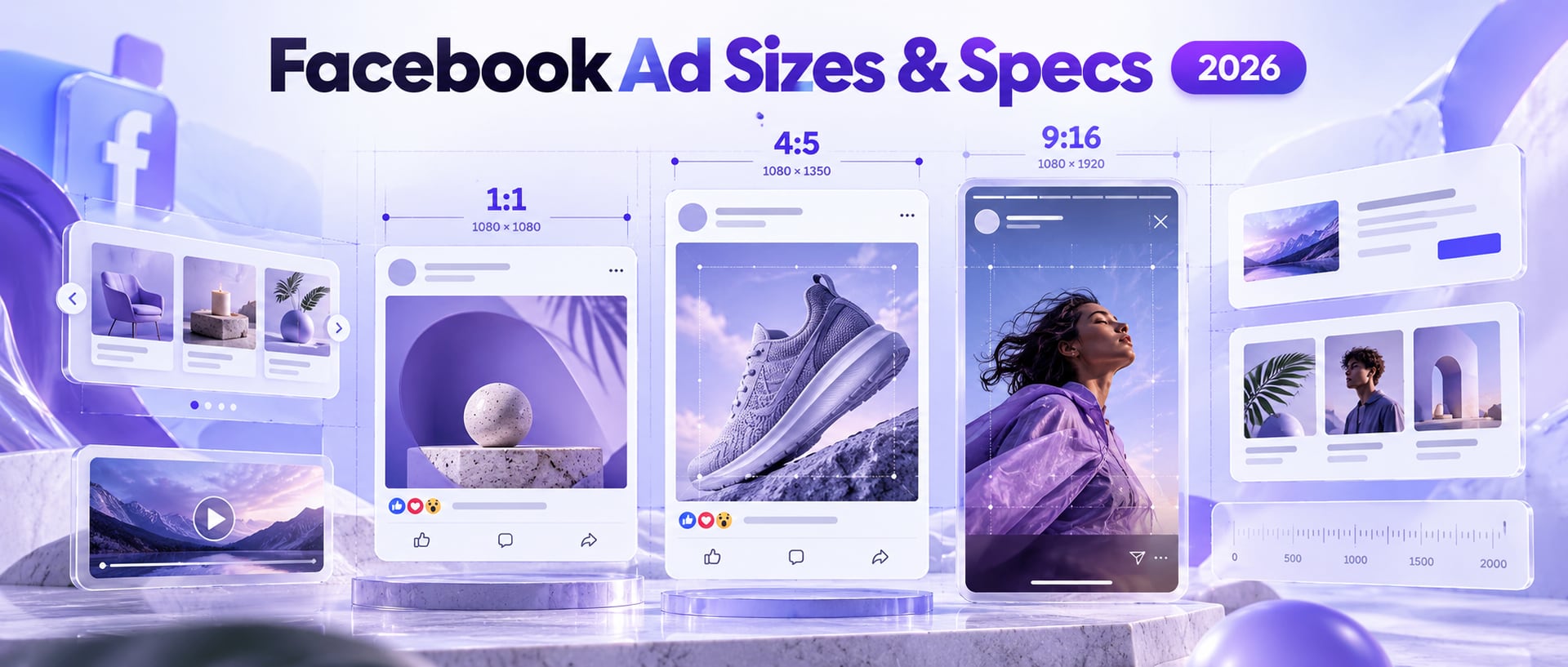
Facebook ad sizes look complicated because Meta lists a separate spec for every placement. In practice, three shapes cover almost everything: 4:5 for Feed, 9:16 for Stories and Reels, and 1:1 for carousel, Marketplace and search. Get the shape right first, then export at Meta's recommended resolution.
Feed: 1440 × 1800 px (4:5). Stories and Reels: 1440 × 2560 px (9:16). Carousel, Marketplace, search: at least 1080 × 1080 px (1:1). Images up to 30 MB, video up to 4 GB. These are the figures in Meta's Ads Guide, checked on 9 October 2026.
You'll still see 1080 × 1350 and 1080 × 1920 in plenty of guides. Those are the same shapes at a lower resolution and they upload without problems. Meta's own recommendation moved to the 1440 versions, so that's what this guide leads with.
Every Facebook ad placement, drawn to scale
Pick a placement to see its canvas at the real aspect ratio, Meta's safe zones where it publishes them, and the specs that matter. Switch between image and video where both exist.
- File type
- JPG or PNG
- Primary text
- 50 to 150 characters
- Headline
- 27 characters
- Max file size
- 30 MB
- Minimum
- 600 px wide, 750 px tall at 4:5
- Ratio tolerance
- 3%
4:5 takes up more of a phone screen than a square. Keep a 1:1 version for placements that need it.
- Facebook Feed image: 4:5, 1440 × 1800
- File type: JPG or PNG. Primary text: 50 to 150 characters. Headline: 27 characters. Max file size: 30 MB. Minimum: 600 px wide, 750 px tall at 4:5. Ratio tolerance: 3%. 4:5 takes up more of a phone screen than a square. Keep a 1:1 version for placements that need it.
- Facebook Feed video: 4:5, 1440 × 1800
- File type: MP4, MOV or GIF. Settings: H.264, square pixels, fixed frame rate, progressive scan, stereo AAC 128 kbps+. Length: 1 second to 241 minutes. Max file size: 4 GB. Minimum: 120 × 120 px. 4:5 takes up more of a phone screen than a square. Keep a 1:1 version for placements that need it.
- Facebook Stories image: 9:16, 1440 × 2560
- File type: JPG or PNG. Primary text: 125 characters. Headline: 40 characters. Max file size: 30 MB. Minimum width: 500 px. Ratio tolerance: 1%. The bottom of a Story image is the call to action. Meta asks for 35% clear space there, more than for video.
- Facebook Stories video: 9:16, 1440 × 2560
- File type: MP4, MOV or GIF. Length: 1 second to 3 minutes. Primary text: 125 characters. Headline: 40 characters. Max file size: 4 GB. Minimum width: 250 px. Ratio tolerance: 1%. The bottom of a Story image is the call to action. Meta asks for 35% clear space there, more than for video.
- Facebook Reels image: 9:16, 1440 × 2560
- File type: JPG or PNG. Text on image: Meta recommends none. Primary text: 40 characters. Headline: 55 characters. Max file size: 30 MB. Minimum: 600 × 600 px. Ratio tolerance: 3%. Captions, the CTA and buttons sit over the lower part of a Reel. Meta gives no exact figure, so preview it in Ads Manager.
- Facebook Reels video: 9:16, 1440 × 2560
- File type: MP4, MOV or GIF. Settings: H.264, fixed frame rate, stereo AAC over 128 kbps. Length: No maximum. Primary text: 40 characters. Headline: 55 characters. Max file size: 4 GB. Captions, the CTA and buttons sit over the lower part of a Reel. Meta gives no exact figure, so preview it in Ads Manager.
- Facebook Carousel image: 1:1 per card, At least 1080 × 1080
- Cards: 2 to 10. File type: JPG or PNG, or MP4, MOV, GIF. Primary text: 80 characters. Headline: 20 characters. Description: 18 characters. Max file size: 30 MB image, 4 GB video. Video length: 1 second to 240 minutes. Landing page: Required. Carousel headlines are short: 20 characters. Write them before you design the cards.
- Facebook Marketplace image: 1:1, At least 1080 × 1080
- File type: JPG or PNG. Primary text: 125 characters. Headline: 40 characters. Description: 30 characters. Max file size: 30 MB. People here are shopping. Show the product or the result plainly.
- Facebook Right column image: 1:1, At least 1080 × 1080
- File type: JPG or PNG. Text on image: Meta recommends none. Headline: 40 characters. Minimum: 254 × 133 px. Desktop only, and shown small. One clear subject, no words in the image.
- Facebook Search image: 1:1, At least 1080 × 1080
- Ratio: 1.91:1 to 1:1. File type: JPG or PNG. Primary text: 125 characters. Headline: 40 characters. Description: 30 characters. Max file size: 30 MB. Minimum: 600 × 600 px. Ratio tolerance: 3%. A square is the safest single file for search.
- Facebook Search video: 1:1, At least 1080 × 1080
- Ratio: 1:1. Length: 1 second to 241 minutes. A square is the safest single file for search.
- Facebook Collection image: 1:1, At least 1080 × 1080
- Ratio: 1.91:1 to 1:1. Cover: First image or video of your Instant Experience. Primary text: 125 characters. Headline: 40 characters. Max file size: 30 MB image, 4 GB video. Instant Experience: Required. The cover is pulled from your Instant Experience, so design that first frame as the ad.
- Facebook Page cover image: 2.7:1, 851 × 315
- Minimum: 400 × 150 px. Fastest to load: sRGB JPG under 100 KB. On computers: Shown at 16:9, left aligned. On phones: Shown at 2.4:1; profile picture overlaps by about 40 px. Profile picture: 320 × 320 px for best quality. Not an ad: this is your Page's banner. Keep logos and words near the centre, then check it on a phone.
Facebook ad sizes at a glance
| Placement | Ratio | Recommended size | Max file size |
|---|---|---|---|
| Feed image | 4:5 (1:1 also runs) | 1440 × 1800 px | 30 MB |
| Feed video | 4:5 | 1440 × 1800 px | 4 GB |
| Stories image and video | 9:16 | 1440 × 2560 px | 30 MB / 4 GB |
| Reels video | 9:16 | 1440 × 2560 px | 4 GB |
| Carousel | 1:1 per card | At least 1080 × 1080 px | 30 MB / 4 GB |
| Collection | 1.91:1 to 1:1 | At least 1080 × 1080 px | 30 MB / 4 GB |
| Marketplace | 1:1 | At least 1080 × 1080 px | 30 MB |
| Right column | 1:1 | At least 1080 × 1080 px | No text on image |
| Search results | 1.91:1 to 1:1 | At least 1080 × 1080 px | 30 MB |
Source: Meta Ads Guide, each placement checked on 9 October 2026.
Facebook ad size dimensions: pixels vs aspect ratio
Two different numbers get called “size”. Aspect ratio is the shape, like 4:5. Pixel dimensions are the resolution, like 1440 × 1800. Meta places ads by shape: a 4:5 image fills a Feed slot whether it's 1080 or 1440 pixels wide. Resolution decides how sharp it looks.
Shape also has a tolerance. Meta allows a 3% difference from the stated ratio in Feed, Reels images, carousel and search, and only 1% in Stories. Outside that, your image gets cropped or letterboxed.
| Ratio | Recommended size | Smaller, same shape | Where it fits |
|---|---|---|---|
| 1:1 | 1440 × 1440 | 1080 × 1080 | Carousel, Marketplace, right column, search, collection, Feed |
| 4:5 | 1440 × 1800 | 1080 × 1350 | Feed on mobile |
| 9:16 | 1440 × 2560 | 1080 × 1920 | Stories and Reels |
| 1.91:1 | 1910 × 1000 | 1200 × 628 | Search and collection (the widest they accept) |
Facebook Feed ad sizes
Feed is where most Facebook ads run, and it's where shape makes the biggest difference. A 4:5 image is 25% taller than a square at the same width, so it covers more of the phone screen as people scroll.
Facebook Feed image ad specs
- Ratio: 4:5 recommended; 1:1 also runs.
- Resolution: 1440 × 1800 px.
- File type: JPG or PNG.
- Max file size: 30 MB.
- Minimum: 600 px wide, and 750 px tall at 4:5.
- Text: primary text 50 to 150 characters, headline 27 characters.
Source: Meta Ads Guide, Facebook Feed image.
Facebook ad image size: 1:1 or 4:5?
| Shape | Use it when | Upside | Watch out for |
|---|---|---|---|
| 1:1 square | One image has to run in many placements | Easy to reuse, predictable crop | Less height in Feed |
| 4:5 vertical | Mobile Feed matters most | More of the screen | Needs a separate square for carousel and Marketplace |
For lead generation, 4:5 usually earns its place: the extra height gives you room for the offer, a face or product, and a bit of proof without shrinking everything. It doesn't guarantee better results, it just gives the design more room to work.
Note that Meta's recommended minimum pixel guidance lists 1440 × 1800 for 4:5 Feed. A 1080 × 1350 file still uploads, but if you're making new creative, start at 1440.
Facebook video ad specs
Video follows the same shapes: 4:5 for Feed, 9:16 for Stories and Reels. What changes by placement is the allowed length.
| Placement | Ratio and size | Length | Max file size |
|---|---|---|---|
| Feed | 4:5, 1440 × 1800 | 1 second to 241 minutes | 4 GB |
| Stories | 9:16, 1440 × 2560 | 1 second to 3 minutes | 4 GB |
| Reels | 9:16, 1440 × 2560 | No maximum | 4 GB |
| Carousel | 1:1, at least 1080 × 1080 | 1 second to 240 minutes | 4 GB |
| Search | 1:1, at least 1080 × 1080 | 1 second to 241 minutes | 4 GB |
How to export Facebook video ads
- Format: MP4, MOV or GIF. MP4 is the simplest default.
- Video: H.264 compression, square pixels, fixed frame rate, progressive scan.
- Audio: stereo AAC at 128 kbps or more.
- Minimum size (Feed): 120 × 120 px, though you'll want far more.
- Captions: optional, but Meta recommends them. Many people watch with the sound off.
Source: Meta Ads Guide for Feed video, Stories video and Reels video.
A 241-minute limit doesn't mean you should use it. What decides whether a video ad works is the first two or three seconds, so open with the thing you're selling, not a logo animation.
Facebook Story ad size and safe zones
Stories are full screen and vertical, so the shape is 9:16 at 1440 × 2560 px. A square or 4:5 ad can be adapted to fit, but it looks like a recycled Feed post and wastes most of the screen.
- Image: JPG or PNG, up to 30 MB, at least 500 px wide.
- Video: MP4, MOV or GIF, 1 second to 3 minutes, up to 4 GB, at least 250 px wide.
- Text: primary text 125 characters, headline 40.
- Ratio tolerance: 1%, much stricter than Feed.
Stories safe zones: Meta's numbers
Your profile name sits at the top of a Story and the call-to-action button at the bottom. Meta asks you to keep text, logos and other key elements out of those areas:
| Top | Bottom | Sides | |
|---|---|---|---|
| Story image | 14% (about 360 px at 1440 × 2560) | 35% (about 900 px) | 6% each (about 86 px) |
| Story video | About 14% (250 px) | About 20% (340 px) | Not specified |
Source: Meta Ads Guide for Stories image and Stories video. Meta's pixel figures for video match a 1080 × 1920 frame.
On a Story image, a full 35% at the bottom is covered by the call to action. Put your headline and offer in the middle band, and use the top and bottom for background that can be covered.
Facebook Reels ad size
Reels ads should look like Reels: 9:16 vertical at 1440 × 2560 px. A landscape video squeezed into a phone frame is the fastest way to get scrolled past.
- Video: MP4, MOV or GIF, H.264, stereo AAC over 128 kbps, up to 4 GB, no maximum length.
- Image: JPG or PNG, up to 30 MB, at least 600 × 600 px. Meta recommends no text on the image.
- Text: primary text 40 characters, headline 55. Much shorter primary text than Feed.
- Sound: Meta calls it optional but strongly recommended.
Meta's safe zone article covers Stories and Reels together, but the Reels spec itself gives no percentage. Captions, the CTA, the like and share buttons all sit over the lower part and right edge, so use the Stories numbers as a starting point and check the Reels preview in Ads Manager.
Source: Meta Ads Guide, Facebook Reels.
Facebook carousel ad specs
Carousels put 2 to 10 swipeable cards in one ad. They work when the story has parts: several products, steps in a process, rooms in a property, or problems you solve.
| Spec | Carousel |
|---|---|
| Ratio and size | 1:1, at least 1080 × 1080 px per card |
| Cards | 2 to 10 |
| File type | JPG or PNG; MP4, MOV or GIF |
| Max file size | 30 MB image, 4 GB video |
| Video length | 1 second to 240 minutes |
| Primary text | 80 characters |
| Headline | 20 characters |
| Description | 18 characters |
| Landing page URL | Required |
Source: Meta Ads Guide, carousel in Facebook Feed.
That 20-character headline is the spec people miss. Write card headlines before you design, and keep crops and type sizes consistent from card to card so the carousel reads as one piece. The first card has to stop the scroll on its own.
Marketplace, right column, search and collection ad sizes
Facebook Marketplace ad dimensions
1:1, at least 1080 × 1080 px, JPG or PNG up to 30 MB. Primary text 125 characters, headline 40, description 30. People on Marketplace are shopping, so show the product or the result plainly. If you sell a service, make the outcome obvious at a glance (Meta spec).
Facebook right column ad dimensions
1:1, at least 1080 × 1080 px, minimum 254 × 133 px, headline 40 characters. Right column ads appear only on desktop and are shown small, so Meta recommends no text on the image. One clear subject and strong contrast (Meta spec).
Facebook search ad dimensions
1.91:1 to 1:1, at least 1080 × 1080 px, minimum 600 × 600 px, up to 30 MB. Primary text 125 characters, headline 40, description 30. Search video is 1:1. A square is the safest single file (Meta spec).
Facebook collection ad specs
1.91:1 to 1:1, at least 1080 × 1080 px. The cover image or video is the first asset in your Instant Experience, which is required. Primary text 125 characters, headline 40; 30 MB images and 4 GB video (Meta spec).
Facebook ad text limits by placement
These are Meta's recommended lengths. Longer text isn't rejected, but it gets cut off with “See more”, so the point has to land early.
| Placement | Primary text | Headline | Description |
|---|---|---|---|
| Feed image | 50 to 150 | 27 | None |
| Stories | 125 | 40 | None |
| Reels | 40 | 55 | None |
| Carousel | 80 | 20 | 18 |
| Collection | 125 | 40 | None |
| Marketplace | 125 | 40 | 30 |
| Search | 125 | 40 | 30 |
| Right column | None | 40 | None |
Characters, from each placement's page in the Meta Ads Guide.
Need the words as well as the size? Our free Facebook lead ad copy generator writes primary text, headlines and a lead form to these lengths.
The best size for Facebook ads by campaign goal
There is no single best Facebook ad size. Start from where the ad will be seen and how much it has to say.
| Goal | Start with | Why |
|---|---|---|
| Lead generation | 4:5 Feed + 9:16 vertical | Room for the offer in Feed, plus native full-screen |
| Ecommerce | 1:1 carousel + 9:16 Reels | Several products, plus discovery |
| Local services | 4:5 Feed | Space for offer, proof and location |
| Real estate | 4:5 Feed + 9:16 Reels | Property photos benefit from height |
| B2B | 1:1 + 4:5 | Clean layouts that work in Feed |
| Retargeting | 1:1 | Fast to iterate, runs almost everywhere |
| Video-first | 9:16 + 4:5 cut-down | Native vertical plus Feed coverage |
The 3-asset system: one idea, three shapes
You don't need a design per placement. Make three versions of every important concept and assign each to its placements in Ads Manager. It's far better than one square and letting Meta crop it.
Make a 4:5 Feed version
1440 × 1800 px. Your main design, since Feed is where most delivery happens.
Make a 9:16 Stories and Reels version
1440 × 2560 px. Recompose, don't stretch: the headline often needs fewer words because the top 14% and bottom 35% are covered.
Make a 1:1 square version
1440 × 1440 px, which clears every square placement's 1080 × 1080 minimum with room to spare.
Preview every placement
In Ads Manager, use the placement customisation to give each placement its version, then go through every preview before you publish.
Keep the offer, colours and call to action identical across all three. People see your ad in more than one place, and it should feel like the same ad.
A Canva and Figma setup for Facebook ads
Three master frames, named clearly so whoever uploads the ad picks the right file.
| Frame name | Canvas | Use for |
|---|---|---|
| FB_AD_FEED_4x5 | 1440 × 1800 | Feed |
| FB_AD_STORY_REEL_9x16 | 1440 × 2560 | Stories and Reels |
| FB_AD_SQUARE_1x1 | 1440 × 1440 | Carousel, Marketplace, search, right column |
On the 9:16 frame, add guides at 358 px from the top, 896 px from the bottom and 86 px in from each side (14%, 35% and 6% of 1440 × 2560). In Canva, put a locked semi-transparent layer over those areas. It stops the next designer from moving the price into the button.
Does Facebook still have the 20% text rule?
No. Meta used to restrict ads whose image was more than about 20% text. That rule is gone, and ads are not rejected or limited for the amount of text in the image.
That doesn't make heavy text a good idea. Small placements are unreadable with it, which is why Meta recommends no text at all on right column and Reels images. A good rule: the image carries the idea, the primary text carries the explanation, and on-image text is only for what must be read in a second, like the offer.
Facebook cover photo size in 2026
Not an ad, but it's the size people search for most alongside ad sizes, and the numbers get mixed up often. Here's what Meta's own help article says:
| Cover photo | Meta's guidance |
|---|---|
| Loads fastest | 851 × 315 px, sRGB JPG, under 100 KB |
| Minimum | 400 × 150 px |
| On computers | Full bleed, 16:9, left aligned |
| On smartphones | Full bleed, 2.4:1, left aligned |
| Profile picture overlap | About 40 px of the cover on phones |
| Profile picture | 320 × 320 px for best quality; shown at 176 × 176 on computers, 196 × 196 on phones |
Because computers and phones show the cover at different shapes, part of it is always cut off somewhere. Keep the logo, words and faces near the centre, use the edges for background, and check the Page on both a computer and a phone after uploading. For a cover with a logo or sharp text, a PNG keeps edges cleaner than a JPG.
Facebook banner, header and cover: same thing?
Usually. “Facebook banner photo size” and “Facebook header photo size” almost always mean the Page cover. Group and event covers are separate. And if you meant Audience Network banner ads, those run inside other apps, so build from the specs above and check the Audience Network preview in Ads Manager.
A cover is wide Page branding. Ads are 4:5, 9:16 and 1:1. Designing an ad at 851 × 315 guarantees an awful crop in every placement.
Common Facebook ad sizing mistakes
- Using one square for every placement and accepting whatever crop Meta makes.
- Designing Stories or Reels at 1:1 or 4:5 instead of 9:16.
- Putting the headline or price in the bottom 35% of a Story, under the button.
- Making the logo, disclaimer or CTA too small to read on a phone.
- Dropping a landscape video into a vertical placement with no redesign.
- Mixing crops and type sizes across carousel cards.
- Uploading a screenshot or a re-compressed file instead of the original export.
- Writing a 40-character carousel headline when the limit is 20.
- Missing the 1% ratio tolerance in Stories by exporting a slightly off canvas.
- Skipping the placement previews in Ads Manager.
Pre-launch Facebook ad creative checklist
- Each placement has the right shape: 4:5, 9:16 or 1:1.
- Exported from the original design at 1440 px wide where possible.
- Story text and logos clear of the top 14%, bottom 35% and sides.
- Headline readable on a phone, within the placement's character limit.
- Video makes sense with the sound off, ideally with captions.
- Carousel cards consistent, first card strong on its own.
- CTA matches the landing page or instant form.
- Every placement preview checked in Ads Manager.
- The form or destination tested before money is spent.
For lead ads, that last point matters most. Send a test lead with Meta's Lead Ads Testing Tool and make sure it reaches whoever calls it back.
For lead ads, the size is only half the job
The right size makes the ad look professional and avoids ugly crops. Once it works and people fill in your form, what matters is how fast someone replies. Facebook keeps new leads in Leads Centre until someone goes and looks.
LeadSender sends each new lead form submission straight to email, SMS, Google Sheets or your CRM the moment it arrives, so a good ad isn't followed by a slow reply.
More on running Facebook ads: how to create Facebook lead ads, what Facebook ads cost in 2026, how to use the Facebook Ad Library to see competitors' creative, and our Meta Business Suite guide.
Facebook ad sizes FAQs
What is the best size for Facebook ads in 2026?
Meta recommends 1440 × 1800 px (4:5) for Feed and 1440 × 2560 px (9:16) for Stories and Reels. For square placements such as carousel and Marketplace, use at least 1080 × 1080 px (1:1). If you can make only one image, a square travels to the most placements.
What are the Facebook ad dimensions for Feed?
Meta's Ads Guide recommends a 4:5 image at 1440 × 1800 px for Facebook Feed. 1:1 squares also run in Feed. The minimum is 600 px wide, and a 4:5 image must be at least 750 px tall.
Can I still use 1080 × 1350 for Facebook ads?
Yes. 1080 × 1350 is the same 4:5 shape and uploads fine. Meta now recommends 1440 × 1800 for the sharpest result, so export at 1440 when your source allows it.
Can I use 1080 × 1080 for Facebook ads?
Yes. 1080 × 1080 is the minimum Meta recommends for carousel cards, Marketplace, right column, search and collection ads, and it also runs in Feed.
What size is a Facebook Story ad?
9:16 at 1440 × 2560 px. For images, keep roughly 14% at the top, 35% at the bottom and 6% on each side free of text and logos. For video, Meta suggests about 14% (250 px) at the top and 20% (340 px) at the bottom.
What is the Facebook Reels ad size?
9:16 at 1440 × 2560 px, as MP4, MOV or GIF up to 4 GB. Meta sets no maximum length for Reels ad video. Primary text is 40 characters and the headline 55.
What are the Facebook video ad specs?
For Feed: 4:5 at 1440 × 1800 px, MP4, MOV or GIF, H.264 with stereo AAC audio at 128 kbps or more, 1 second to 241 minutes, up to 4 GB. Stories video runs 1 second to 3 minutes at 9:16.
What are the Facebook carousel ad specs?
2 to 10 cards at 1:1, each at least 1080 × 1080 px. Images up to 30 MB, video up to 4 GB and 1 second to 240 minutes. Primary text 80 characters, headline 20, description 18, and a landing page URL is required.
What is the maximum file size for Facebook ads?
30 MB for images and 4 GB for video, across Feed, Stories, Reels, carousel and collection ads.
Does Facebook still have the 20% text rule?
No. Meta no longer rejects or limits ads for the amount of text in the image. It does recommend no text at all for small placements such as right column and Reels images, because it can't be read.
What are Meta ad sizes?
The same sizes apply across Meta's apps because ads are built in one place, Ads Manager. The core shapes are 1:1, 4:5 and 9:16. Instagram placements have their own entries in Meta's Ads Guide with slightly different text limits.
Do Facebook ads crop images automatically?
Meta can adapt one image to several placements, but the crop won't respect your layout. Upload a 4:5, a 9:16 and a 1:1 version and assign each to its placements so nothing important gets cut.
What is the Facebook cover photo size in 2026?
Meta says a cover loads fastest as an sRGB JPG at 851 × 315 px under 100 KB. The minimum is 400 × 150 px. It shows at 16:9 on computers and 2.4:1 on phones, so keep text and logos near the centre.
What size should a Facebook banner or header photo be?
Banner and header usually mean your Page cover photo: 851 × 315 px. That is Page branding, not an ad, so don't use it as an ad template.
What size is a Facebook profile picture?
Meta recommends 320 × 320 px for best quality. It shows at 176 × 176 px on computers and 196 × 196 px on smartphones.
Final takeaway
Facebook ad sizes are simple once you stop treating them as a long list: 4:5 at 1440 × 1800 for Feed, 9:16 at 1440 × 2560 for Stories and Reels, and 1:1 for everything square. Keep Story text inside the safe zone, write to each placement's character limits, and preview every placement before you spend.
Sources
Every spec was checked on 9 October 2026 against Meta's own pages. Meta updates its Ads Guide from time to time; if Ads Manager shows something different, trust Ads Manager.
- Meta Ads Guide: Feed image, Feed video, Stories image, Stories video, Reels, carousel, collection, Marketplace, right column, search
- Meta help center: recommended minimum image pixel requirements
- Meta help center: text overlays and safe zones in Stories and Reels
- Facebook help center: cover photo and profile picture sizes