Live integration

Facebook Leads to Google Sheets

Every lead becomes a row, with a column for every question your form asks.

Start 7-Day FREE TrialNo credit card required · Live in about 3 minutes

Setup

How to connect Facebook Lead Ads to Google Sheets

Most people are live in about three minutes. No code, no Zapier, and your next Facebook lead can be in Google Sheets today.

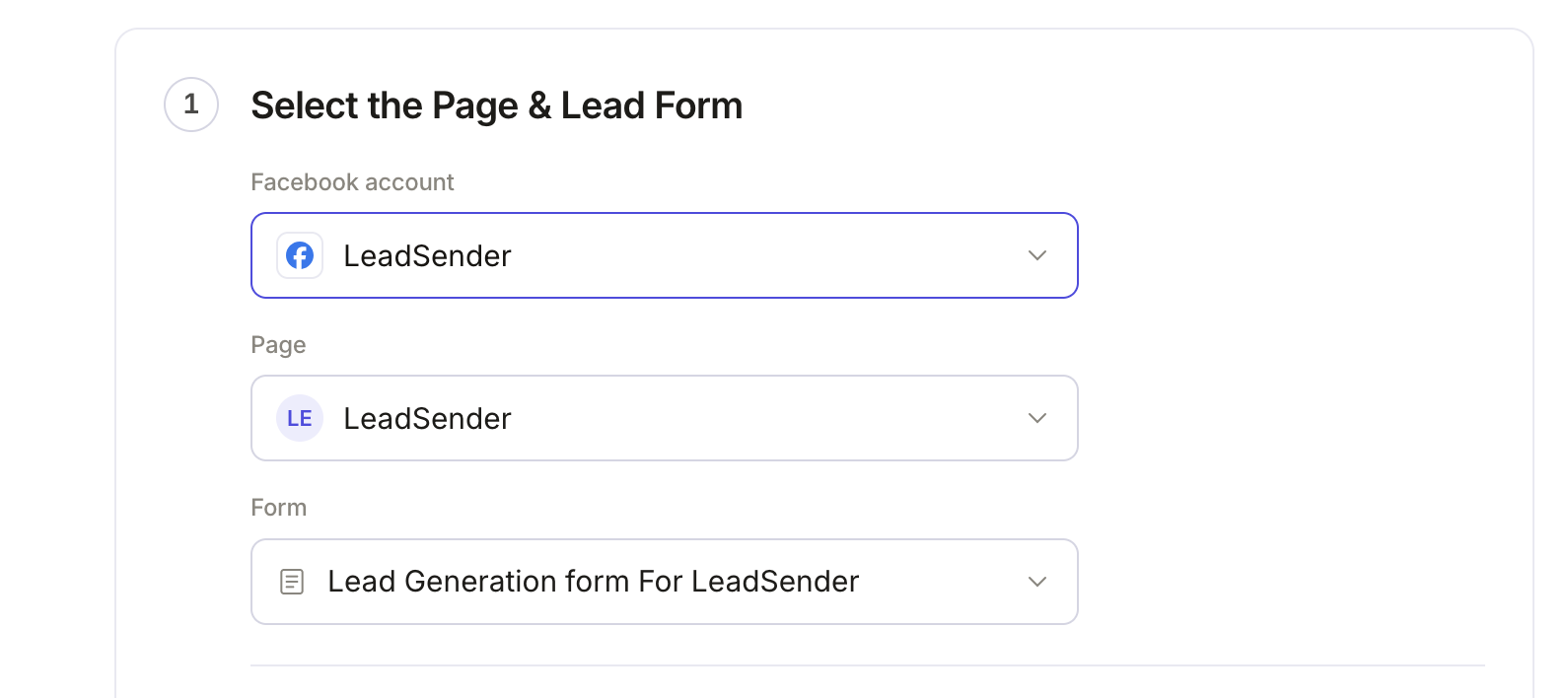
Step 1 of sending Facebook Lead Ads to Google Sheets in LeadSender: the connected Facebook account, the selected Page and the selected lead form
1Step 1 of 4

Connect your Facebook Page and lead form

Sign in with Facebook, then pick the Page you advertise on and the lead form to send to Google Sheets. Every new submission on that form is picked up the moment it happens.

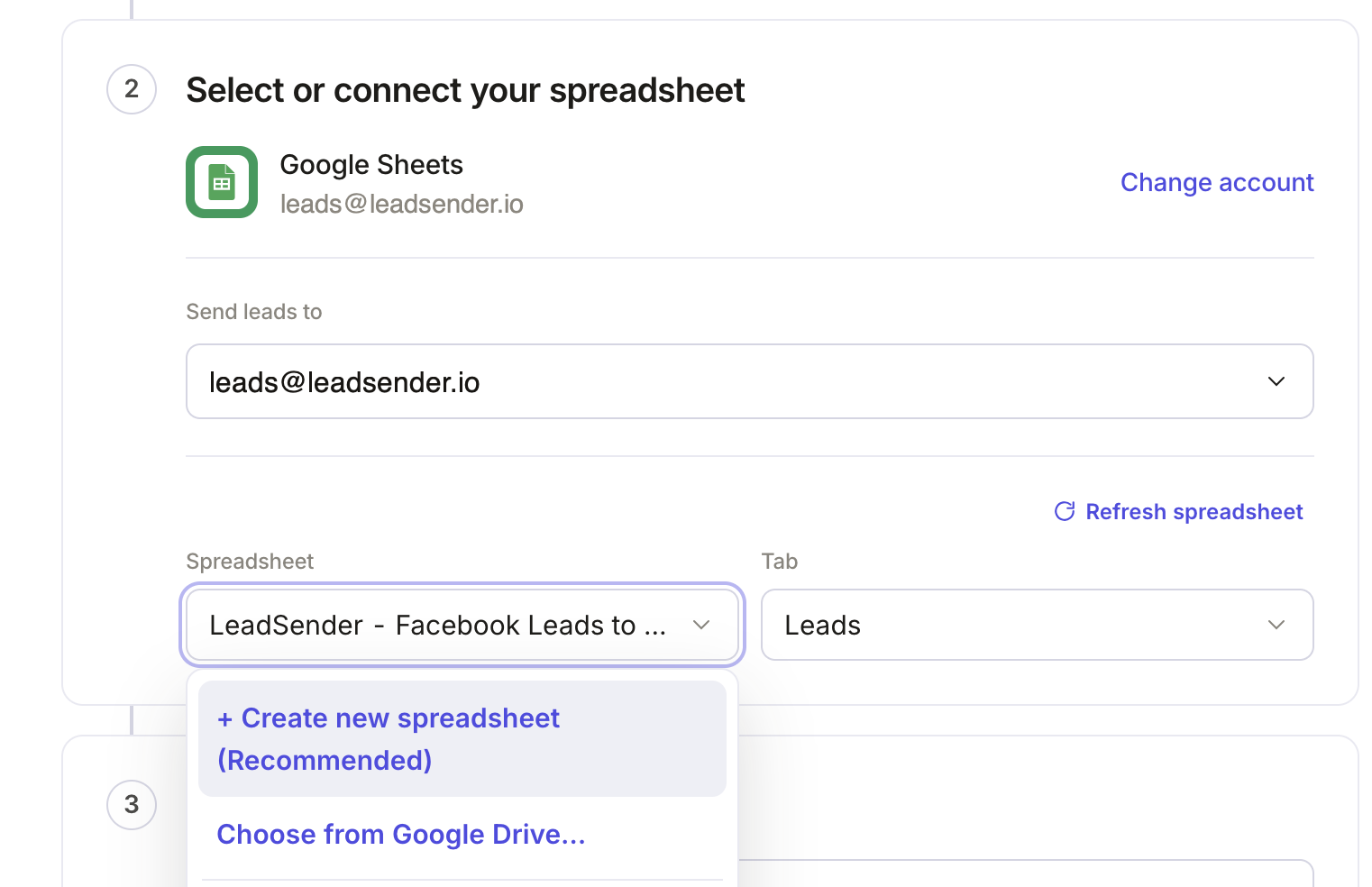
Choosing the Google account, spreadsheet and tab for Facebook leads, with the option to create a new spreadsheet
2Step 2 of 4

Choose the spreadsheet and tab

Connect your Google account and pick any spreadsheet and tab, or let LeadSender create a new Google Sheet with the header row already set up.

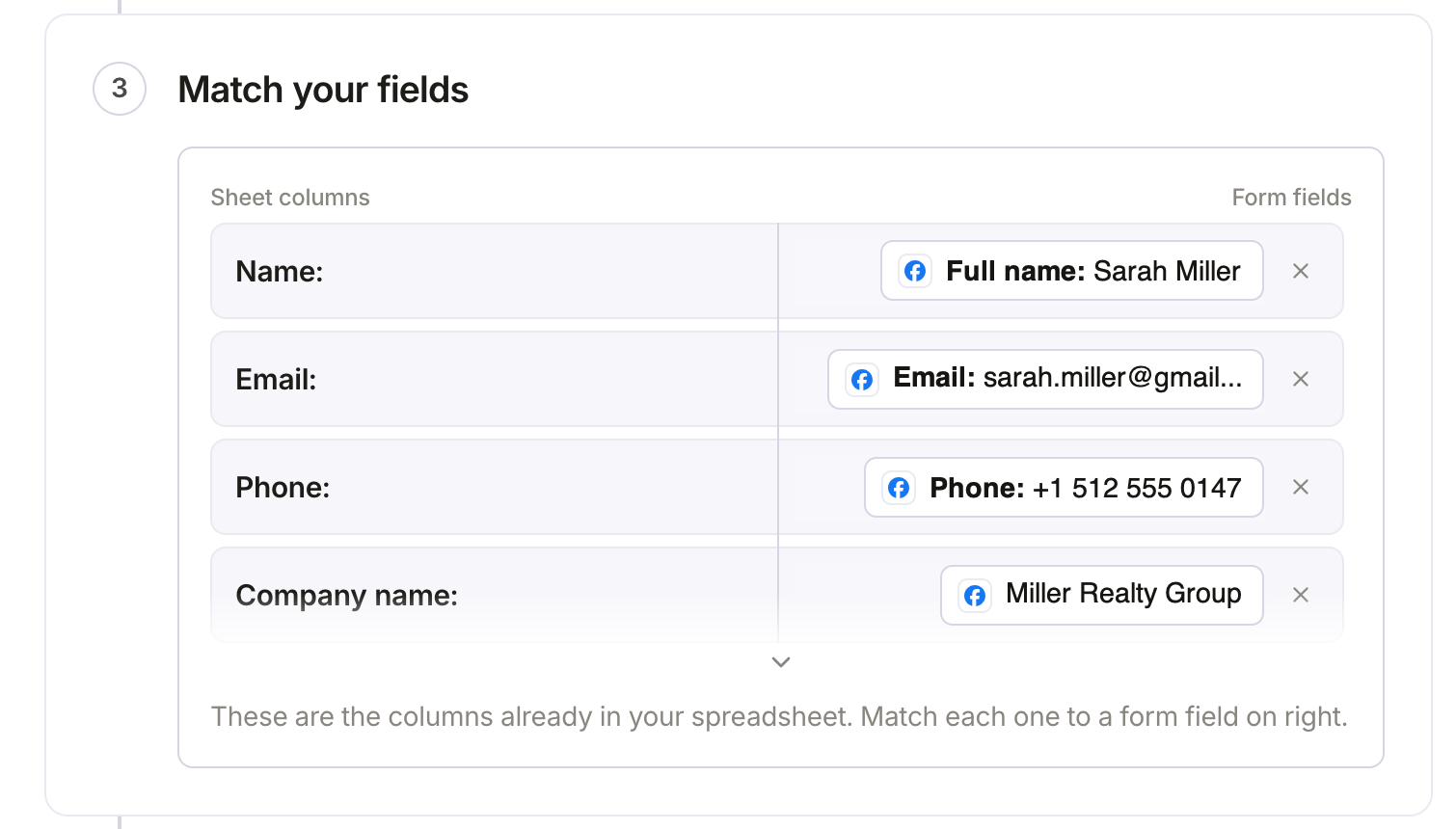
Matching Facebook lead form answers to Google Sheets columns: name, email, phone and company
3Step 3 of 4

Match each question to a column

Every answer on your Facebook lead form gets its own column, so the sheet stays sortable and filterable instead of one long text cell.

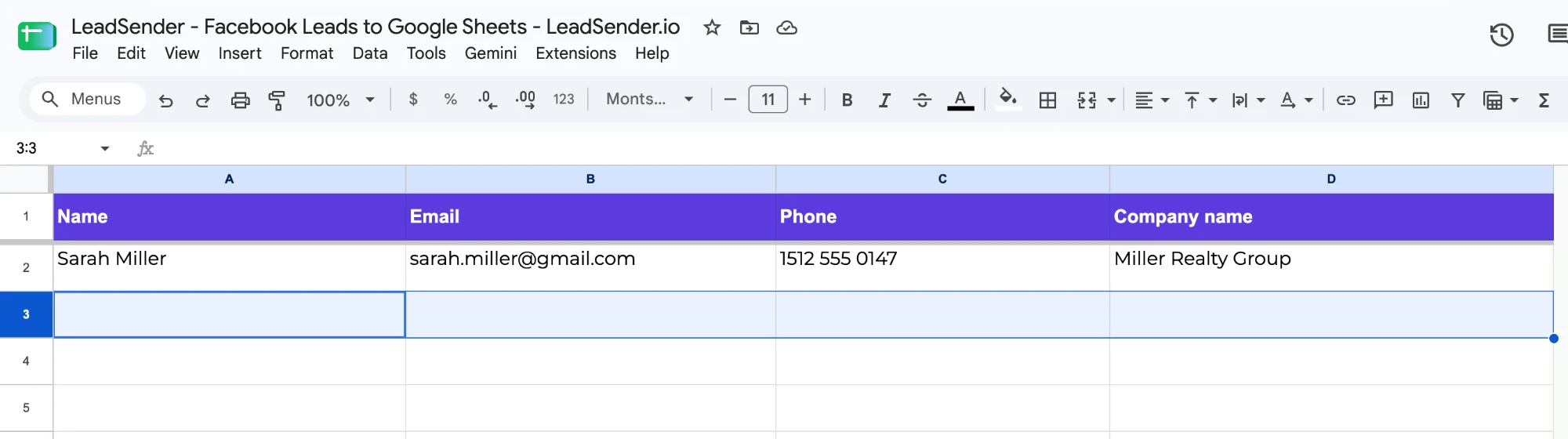
A Google Sheet with a header row (Name, Email, Phone, Company name) and a new Facebook lead in its own row
4Step 4 of 4

Each lead lands as a new row

The moment a lead submits your form, a new row is appended to the tab you chose. Share the sheet with your team and everyone sees leads as they come in.

Start 7-Day FREE TrialNo credit card required · Live in about 3 minutes

Prefer to read it all first? How to send Facebook lead ads to Google Sheets →

What arrives

What LeadSender sends to Google Sheets

One new row appended to the tab you choose, the instant the lead is submitted. Each mapped field gets its own column, so the sheet stays sortable and filterable instead of collapsing into one text blob.

Alongside the answers themselves, each lead carries the campaign and ad it came from, the Facebook Page name and the time it was submitted, so the row tells the whole story of where that lead came from, not just what they typed. Every lead is also scored before delivery, with real checks on the email address and phone number, flagged right there in the sheet rather than sitting silently as a dead entry.

Who it suits

Who sends Facebook leads to Google Sheets

Anyone who wants a running record they can filter, pivot and hand to a VA, and teams who report on lead volume without paying for a CRM to do it.

This isn't a database or a project tool. It's the one route that keeps your sheet current the moment a lead actually exists, instead of someone opening Facebook Lead Center to copy it in by hand.

This is the Facebook Lead Ads integration for Google Sheets, Google Spreadsheet and Google Drive spreadsheet, so whichever name you know it by, the setup above is the same.

Use cases

Ways to use the Facebook Ads to Google Sheets integration

  • Keeping a shared lead list the whole team can see without Ads Manager access
  • Reporting on Facebook lead volume and cost per lead by campaign
  • Handing leads to a client or partner through a shared Google Sheet
  • A simple lead tracker for small teams before they need a CRM

About the tools

Facebook Lead Ads, Google Sheets and LeadSender

Facebook Lead Ads

Facebook Lead Ads, now Meta lead ads, let people send you their details through an instant form on Facebook or Instagram without leaving the app. The form pre-fills from their profile, which is why these ads convert well and why the leads go cold fast if nobody follows up.

Google Sheets

Google Sheets is Google's free, web-based spreadsheet. Teams share one sheet, sort and filter it, and build formulas and reports on top, which makes it the simplest place to keep a running list of every lead.

LeadSender

LeadSender connects Facebook and Instagram lead ads to the tools you already use. It listens to Meta's leadgen webhook, maps each answer to a real field and delivers every lead in seconds, with a LeadScore quality check on the way. No Zapier, no CSV exports.

FAQ

Facebook Leads to Google Sheets FAQs

How do I send Facebook leads to Google Sheets?

Connect your Facebook Page in LeadSender, choose Google Sheets as the destination, and map each question on your lead form to a field. Sign in with Google and grant access to Sheets, then pick the spreadsheet and the specific tab within it. LeadSender reads the real list of spreadsheets and tabs from your own Drive, so you choose from what actually exists. Once it is switched on, every new submission is delivered automatically.

How fast do leads reach Google Sheets?

Seconds. LeadSender is subscribed to Meta's leadgen webhook, so Facebook tells us the moment a form is submitted and we deliver straight on to Google Sheets. There is no polling window and no sync schedule to wait for.

Do I need Zapier to connect Facebook Lead Ads to Google Sheets?

No. LeadSender talks to Meta and to Google Sheets directly, so there is no Zapier plan to pay for on top and no extra hop for a lead to get stuck in.

Can I map my own custom fields in Google Sheets?

Yes. When you connect Google Sheets, LeadSender reads the live field list from your own account, standard fields and the custom ones you created, so you map each form answer to the field your team actually uses instead of to a fixed list.

Can LeadSender create the Google Sheet for me?

Yes. Choose Create new spreadsheet and LeadSender makes one in your Google Drive with a header row that matches your form, so there is nothing to set up by hand.

Will my old Facebook leads be added to the spreadsheet?

No, only new leads from the moment you switch the integration on. For earlier leads, download them as a CSV from Meta Ads Manager and paste them in once.


Start sending Facebook leads to Google Sheets today.

Start Your Free TrialNo credit card required · Cancel anytime