










We spend a lot of time inside GoHighLevel. LeadSender delivers Facebook and Instagram leads into it, we built and run an app on the HighLevel Marketplace, and a good share of our customers are agencies who live in sub-accounts all day. So this isn't a feature list copied from a sales page. It's what the GoHighLevel CRM is good at, what it really costs, and who should honestly pick something smaller.
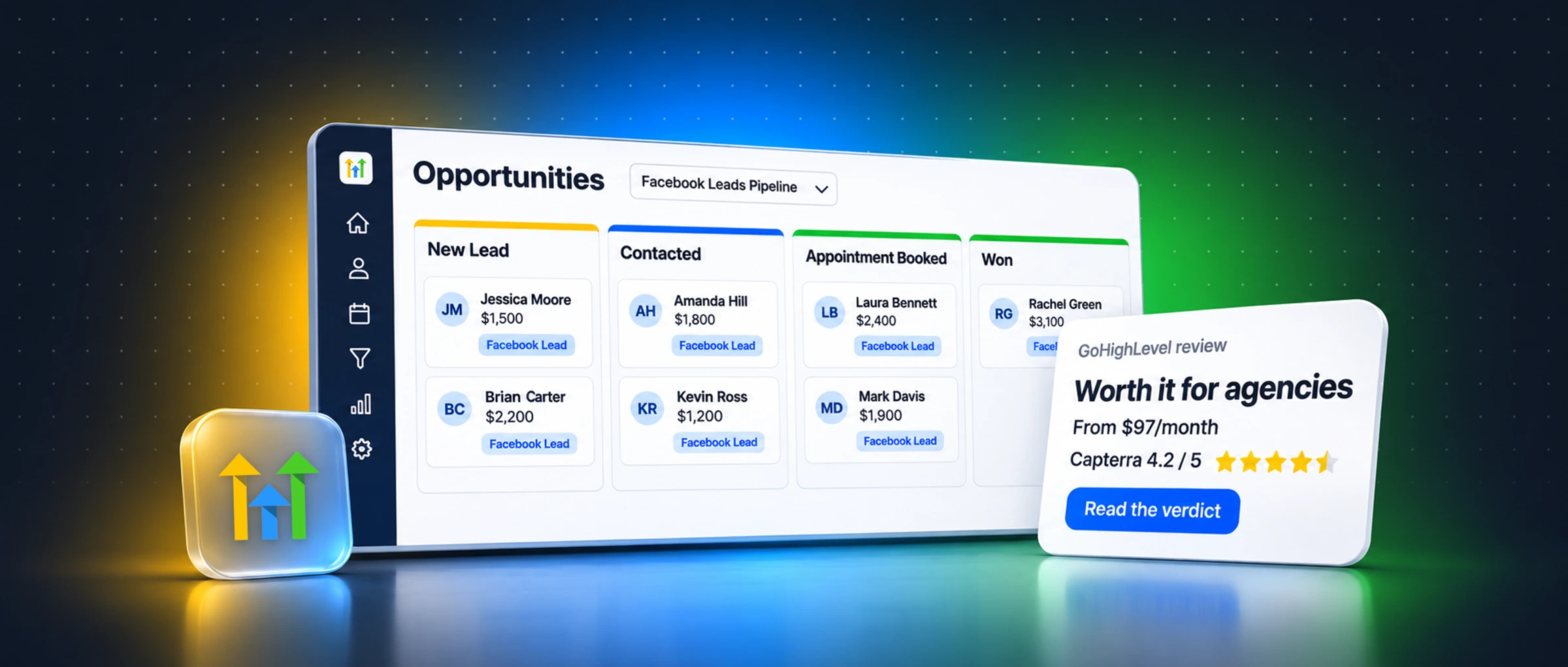
GoHighLevel is worth it if you run an agency or a lead-driven service business and you'll actually use the pieces together: pipelines, automated follow-up, calendars and client sub-accounts. Plans run from $97 to $497 a month, with phone, SMS, email and AI usage on top. If you only need a simple CRM or a newsletter tool, it's more system, and more setup, than you need.
What is GoHighLevel?
GoHighLevel is an all-in-one sales and marketing platform. The company now calls itself just HighLevel, but most people still search for GoHighLevel, Go High Level or GHL, and the website is still gohighlevel.com. All of those names mean the same product.
The idea is simple. Instead of paying for a CRM, a funnel builder, a scheduling tool, a texting tool and an email platform, and then gluing them together, you get all of it under one login, sharing one contact record:
- A CRM with contacts, opportunities and as many sales pipelines as you need
- Workflows that automate follow-up, reminders, tasks and lead routing
- One inbox for email, SMS and connected messaging channels
- Forms, surveys, landing pages, funnels and full websites
- Calendars and appointment booking
- Email and SMS marketing, calling, and AI tools for conversations and voice
- Review requests and reputation management, social posting
- Payments, invoices, courses and communities
- For agencies: client sub-accounts, snapshots, white label and SaaS Mode
That last line is the part most reviews skip, and it's the key to understanding who HighLevel is for.
Who GoHighLevel is really built for
HighLevel was built for marketing agencies first. Your agency account sits above a set of sub-accounts (HighLevel also calls them locations), one per client. Each sub-account has its own contacts, pipelines, calendars, phone numbers, workflows and users, and the client only sees their own.
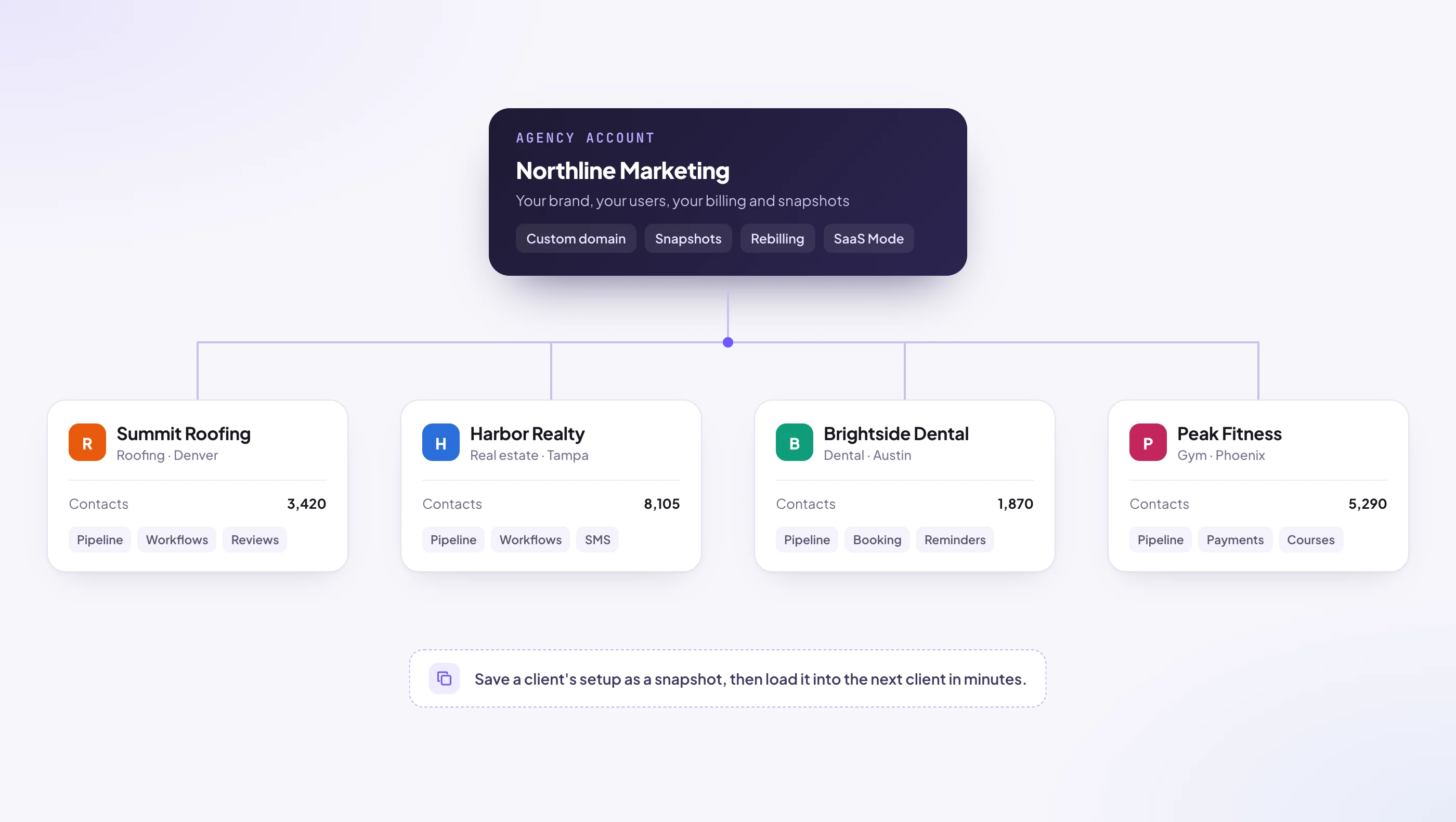
This is where HighLevel pulls ahead of most CRMs. Build a lead funnel, pipeline and follow-up sequence once for a roofing client, save it as a snapshot, and load it into the next roofing client in minutes. A freelancer might only ever need two sub-accounts. An agency with forty clients gets the same tooling for every one of them under a single bill.
Single businesses use HighLevel too, especially local service businesses with steady lead flow: home services, clinics, real estate teams, coaches. They just don't benefit from the agency layer, so the value has to come from replacing other tools.
GoHighLevel pricing in 2027
GoHighLevel pricing has three public plans and a custom Enterprise tier. Every standard plan includes unlimited contacts and unlimited users, so you're not paying per seat. What changes between plans is the number of client sub-accounts, API access, and how you can bill clients for usage.
| Plan | Monthly | Yearly | Sub-accounts | What it adds |
|---|---|---|---|---|
| Starter | $97 | $970 | 3 | Unlimited contacts and users, 24/7 support, all core features |
| Unlimited | $297 | $2,970 | Unlimited | Basic API access, rebill phone and email to clients at cost |
| Agency Pro | $497 | $4,970 | Unlimited | SaaS Mode, automated sub-account creation, rebilling with markup, user and agent reporting, advanced API |
| Enterprise | Custom quote | Custom | Dedicated account manager, premium support, HIPAA, white label mobile app, higher API limits | |
Prices from HighLevel's pricing page, checked October 16, 2026. Paying yearly works out to two months free. Every plan starts with a 14-day free trial.
Starter, $97 a month
The full platform for up to three sub-accounts. It fits a single business, or a freelancer with one or two clients. Nothing core is held back, which surprises people who expect a cut-down entry plan.
Unlimited, $297 a month
The plan most agencies end up on. The three-account cap disappears, you get basic API access, and you can pass phone and email usage straight through to each client at cost. Once you have five or six clients, the per-client cost is lower than most single-purpose tools.
Agency Pro, $497 a month
For agencies that want to sell HighLevel itself. SaaS Mode lets clients sign up and pay you a monthly fee for “your” software, sub-accounts are created automatically, and you can add your own markup to their usage. If you're not planning to resell, Unlimited does everything else.
The real GoHighLevel cost: usage and add-ons
The plan price is the entry ticket, not the bill. HighLevel is upfront that phone calls, SMS, email and AI are charged by usage, and a growing list of features are add-ons:
| Add-on | Price |
|---|---|
| AI Employee Growth | $50/month per sub-account |
| AI Employee Unlimited | $97/month per sub-account |
| Branded Client Portal App | $49/month per sub-account |
| Dedicated email IP | $59/month per IP |
| HIPAA compliance | $297/month |
| Online listings management | $30/month per sub-account |
| Premium prospecting tool | $29/month per sub-account |
| SEO (powered by Search Atlas) | $79/month per sub-account |
| WhatsApp integration | $10/month per sub-account, plus usage |
| White label mobile app | $497/month |
| Premium support | $500/month |
| WordPress hosting | From $10/month per site |
Before you pick a plan, write down: 1. the platform fee, 2. expected usage (texts, calls, emails, AI) per client, and 3. any per-sub-account add-ons. Then compare that total with what you pay today for the tools HighLevel would really replace. That's the honest comparison, and for most agencies it still comes out in HighLevel's favour. For a small business that only needed a CRM, it often doesn't.
The GoHighLevel CRM features that matter
The feature list is long enough to lose the plot. These are the parts that do the work if your goal is turning leads into booked appointments and sales.
CRM and sales pipelines
The Go High Level CRM keeps contacts and opportunities, and lets you run several pipelines side by side, one per service or sales process. A typical one: New Lead, Contacted, Appointment Booked, Proposal Sent, Won or Lost. Each opportunity has an owner, a value and a stage, and moving it to a new stage can kick off automation.
That's the real point of a CRM for paid leads. The ad click isn't the finish line. Every lead needs an owner, a status and a next step, or it quietly dies in someone's inbox.
Conversations
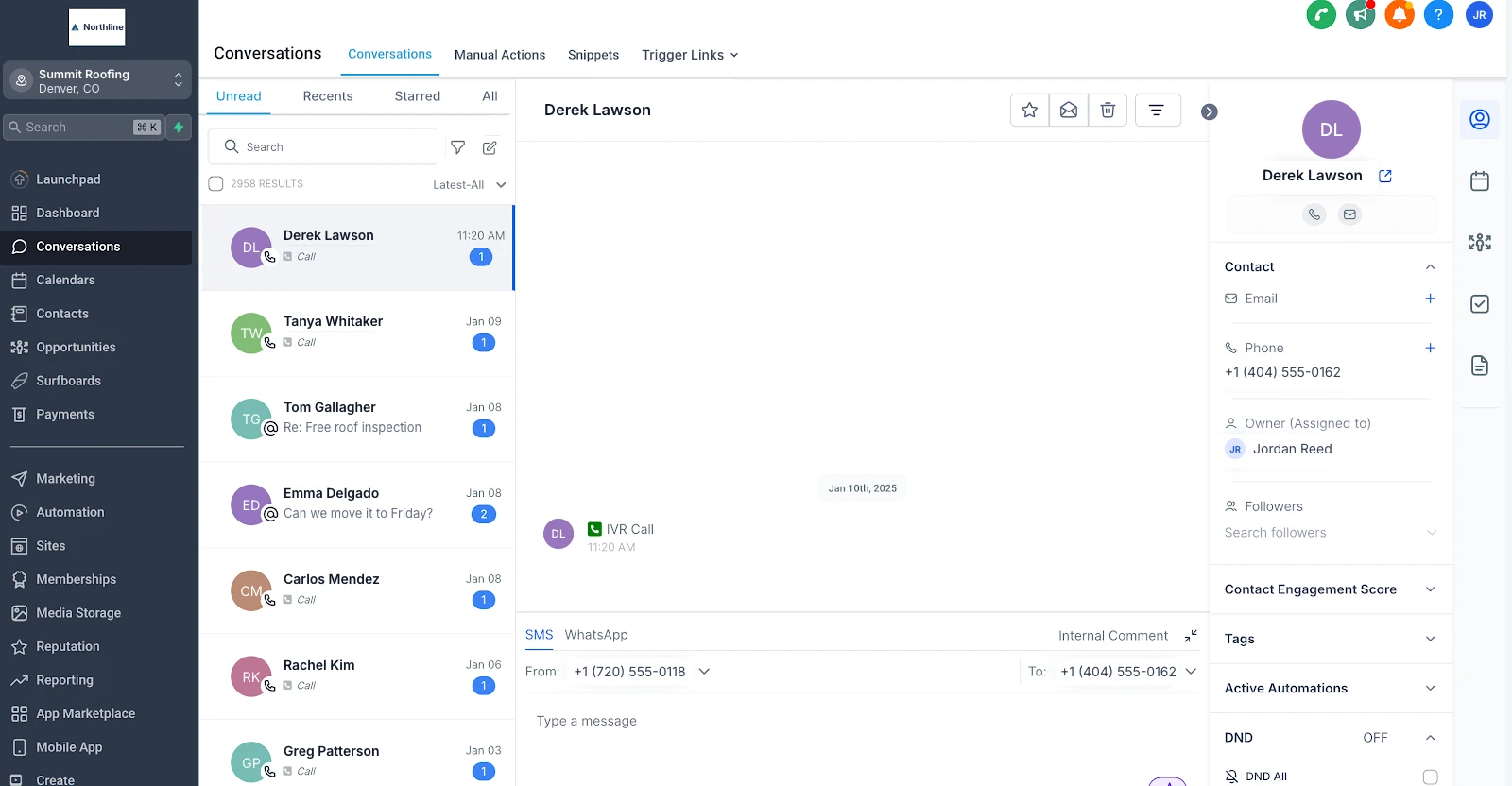
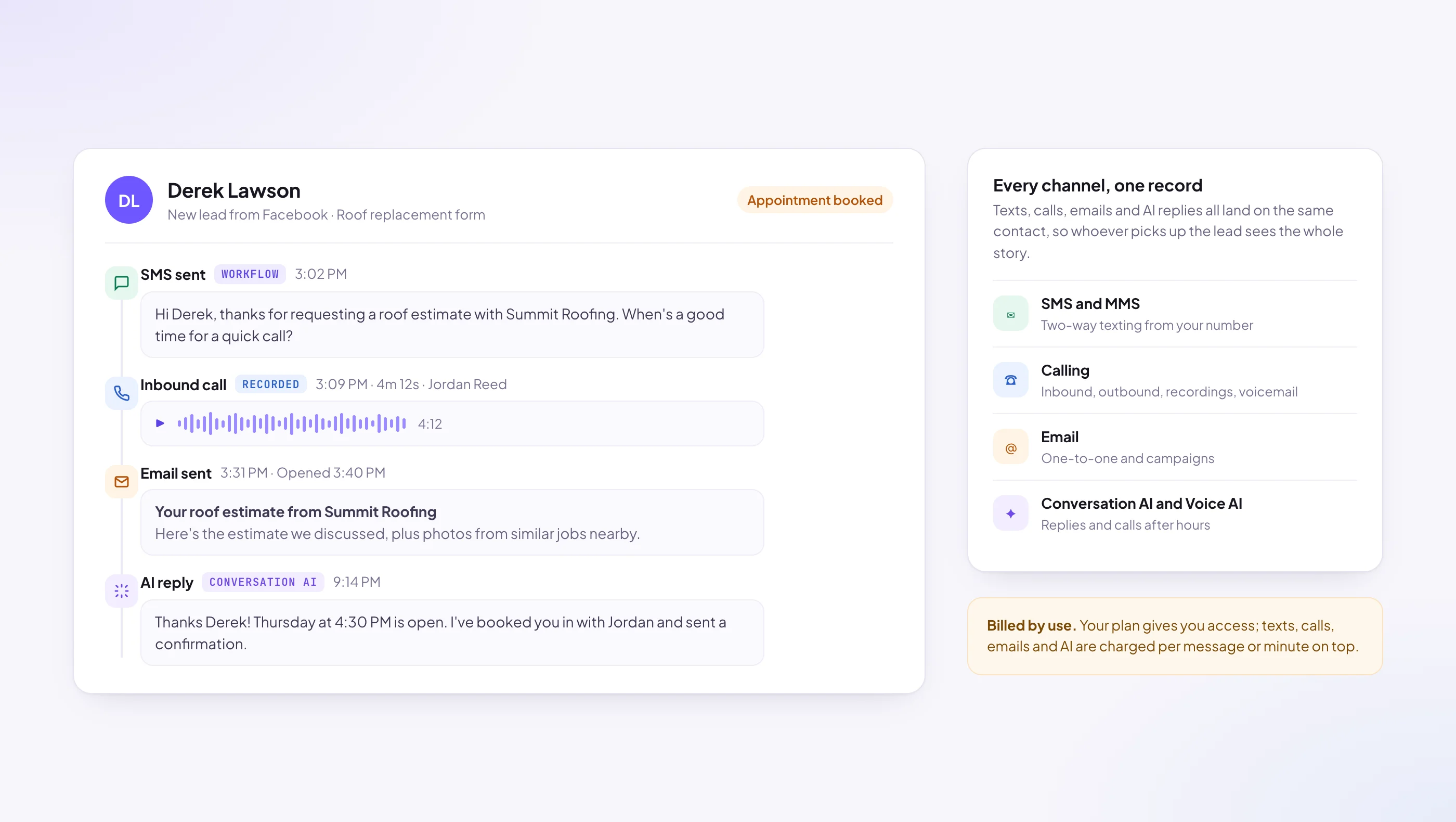
Conversations is HighLevel's shared inbox. Texts, emails and messages from connected channels land in one thread per contact, with the contact's details, tags and pipeline stage beside it. A salesperson can see the whole history and reply from the same screen, instead of switching between their phone, Gmail and the CRM.
Workflow automation
Workflows are where HighLevel stops being a contact database. A trigger (a new lead, a form submission, a booked or missed appointment, a stage change, a payment) starts a series of actions that run on their own. A simple lead workflow looks like this:
- A new lead arrives.
- Text them straight away to say you got their request.
- Notify the salesperson who owns the lead.
- Wait five minutes.
- If they replied, create the opportunity and stop the generic follow-up.
- If not, send the next email or text and create a call task.
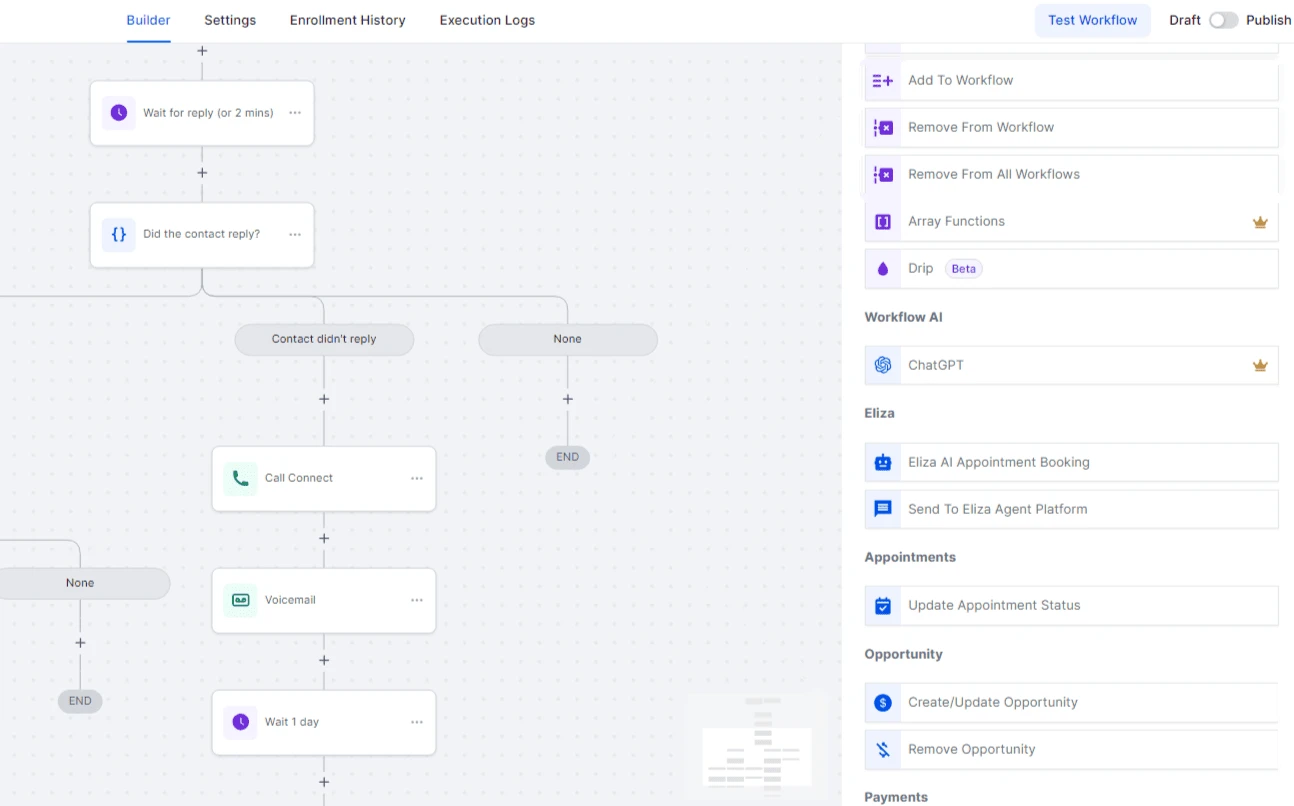
You can start from a template, build from scratch, or describe what you want and let HighLevel's AI draft the workflow for you. Conditions, webhooks and multi-step branches are all there when you need them.
Calendars and booking
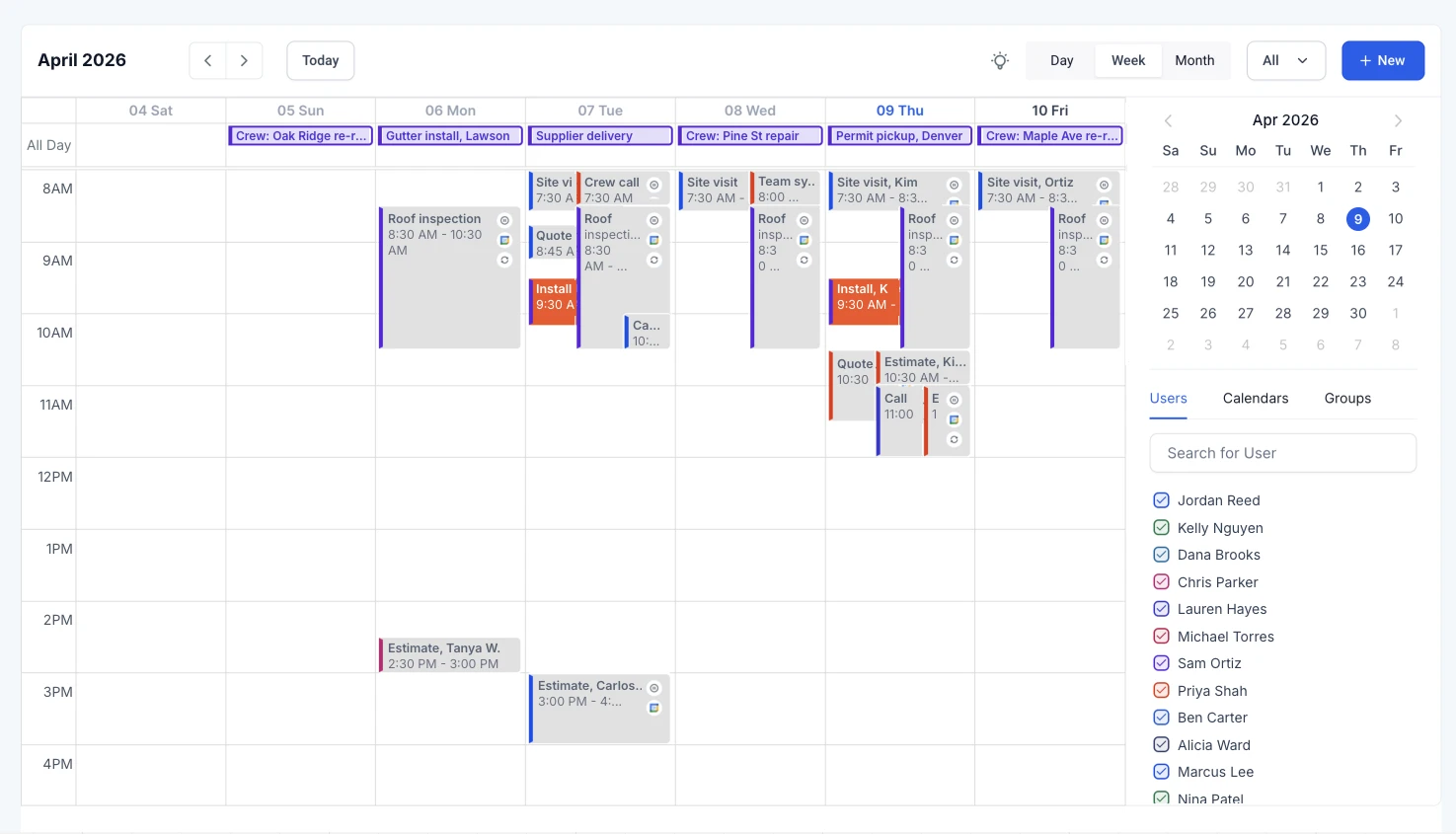
Calendars tie the lead straight to an appointment. Rather than a lead filling a form and waiting for someone to send a scheduling link, the next step can be booking a slot right away, with reminders, confirmations and automatic pipeline updates when someone books, cancels or doesn't show. For clinics, home services and consultants this one feature often justifies the switch.
Forms, surveys and lead capture
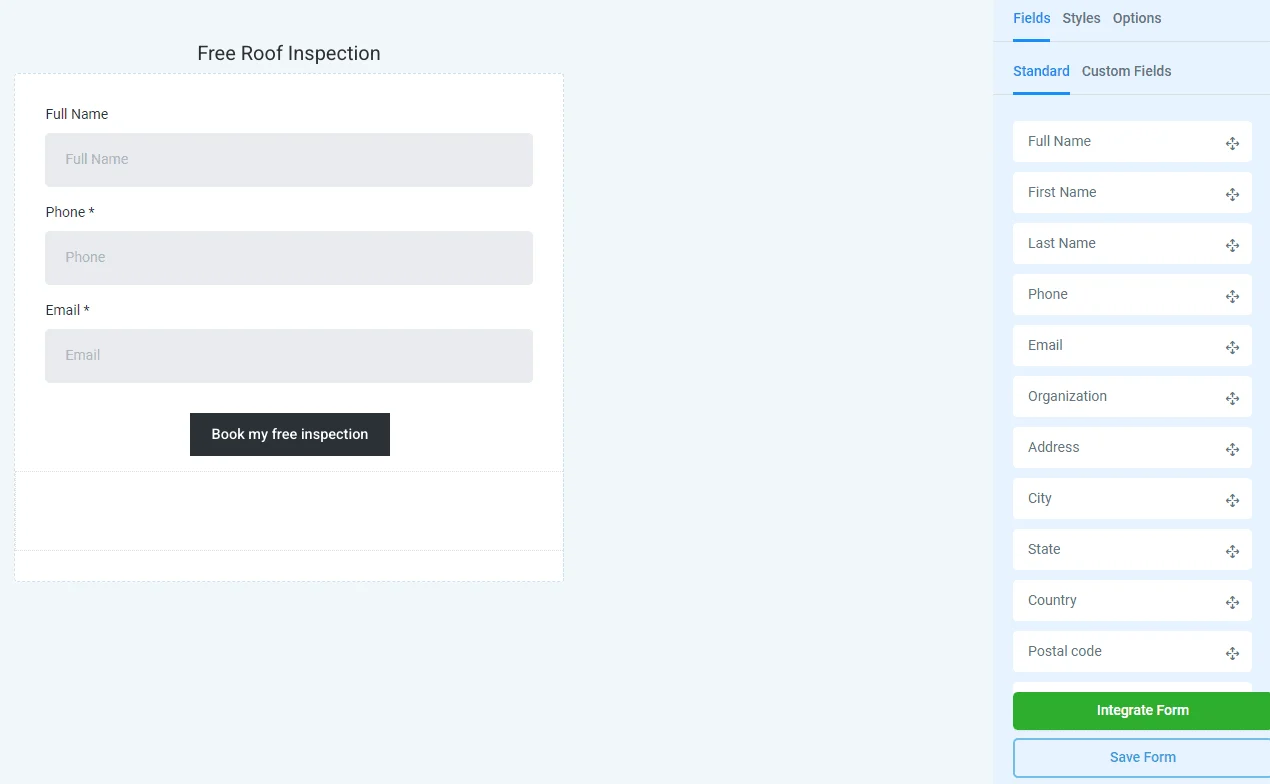
Forms, surveys and quizzes write straight into the CRM. Each submission can tag the contact, create an opportunity, notify the team and start a workflow, with no Zapier step in between. Because the form and the follow-up live together, agencies can save the whole thing as one reusable funnel.
Email, SMS, calling and AI
Email and SMS campaigns, inbound and outbound calling, and AI products such as Conversation AI and Voice AI are all built in. Just remember the pricing point above: the plan gives you access, while sending and calling are billed by use.
Reviews, social and ads
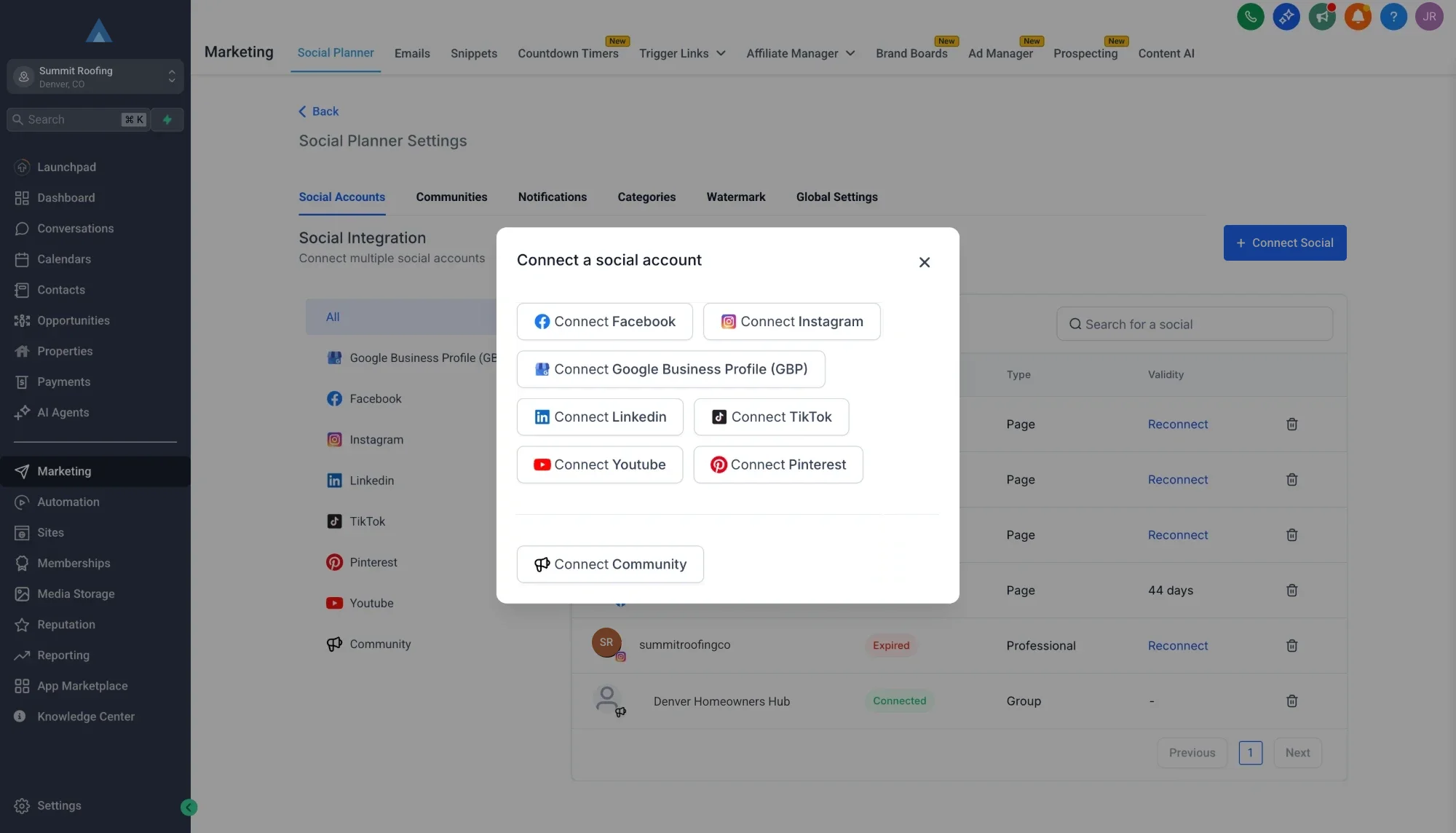
Reputation tools send review requests automatically after a job and collect your reviews in one place. There's social posting, and an Ad Manager for running Facebook and Google ads from inside HighLevel. Ad spend is always paid to the ad platform, separately.
Payments, courses and communities
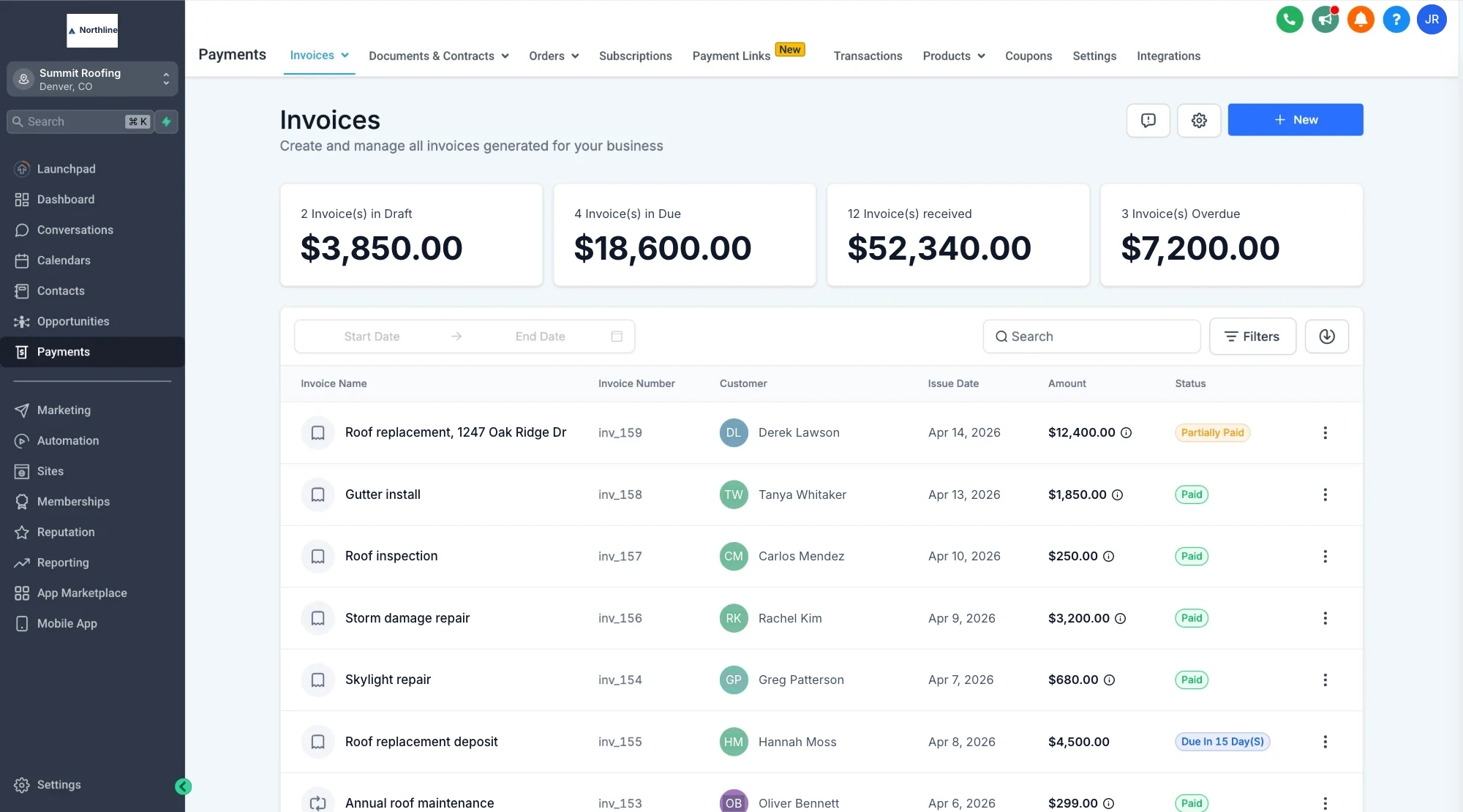
HighLevel also does invoices, payments, online courses and community groups. Great if they replace subscriptions you already pay for. If you'll never use them, they're just more menu items to look past.
Go High Level white label, explained
White label is one of the main reasons agencies choose HighLevel. You run your clients on HighLevel's infrastructure, but they log in at your domain and see your logo and colours, not HighLevel's.
There are really two separate white label decisions, and mixing them up is how people misjudge the cost:
- The web app. Putting your own domain, logo and colours on the desktop web app is part of the platform.
- A mobile app in the app stores under your brand. That's the white label mobile app add-on at $497 a month. A lighter option, the Branded Client Portal App, is $49 a month per sub-account.
Agency Pro goes one step further with SaaS Mode, where clients subscribe to your branded platform and you set the price. That's white label as a business model, rather than just branding.
The GoHighLevel app
The GoHighLevel app is free, and it's listed in the app stores simply as HighLevel, rated 4.5 from about 3,700 ratings on the App Store. There's also an unbranded twin called LeadConnector, which agencies give to clients who shouldn't see the HighLevel name. Either one covers what a salesperson needs away from a desk: replying to conversations, calling and texting leads, checking appointments and moving opportunities along the pipeline.
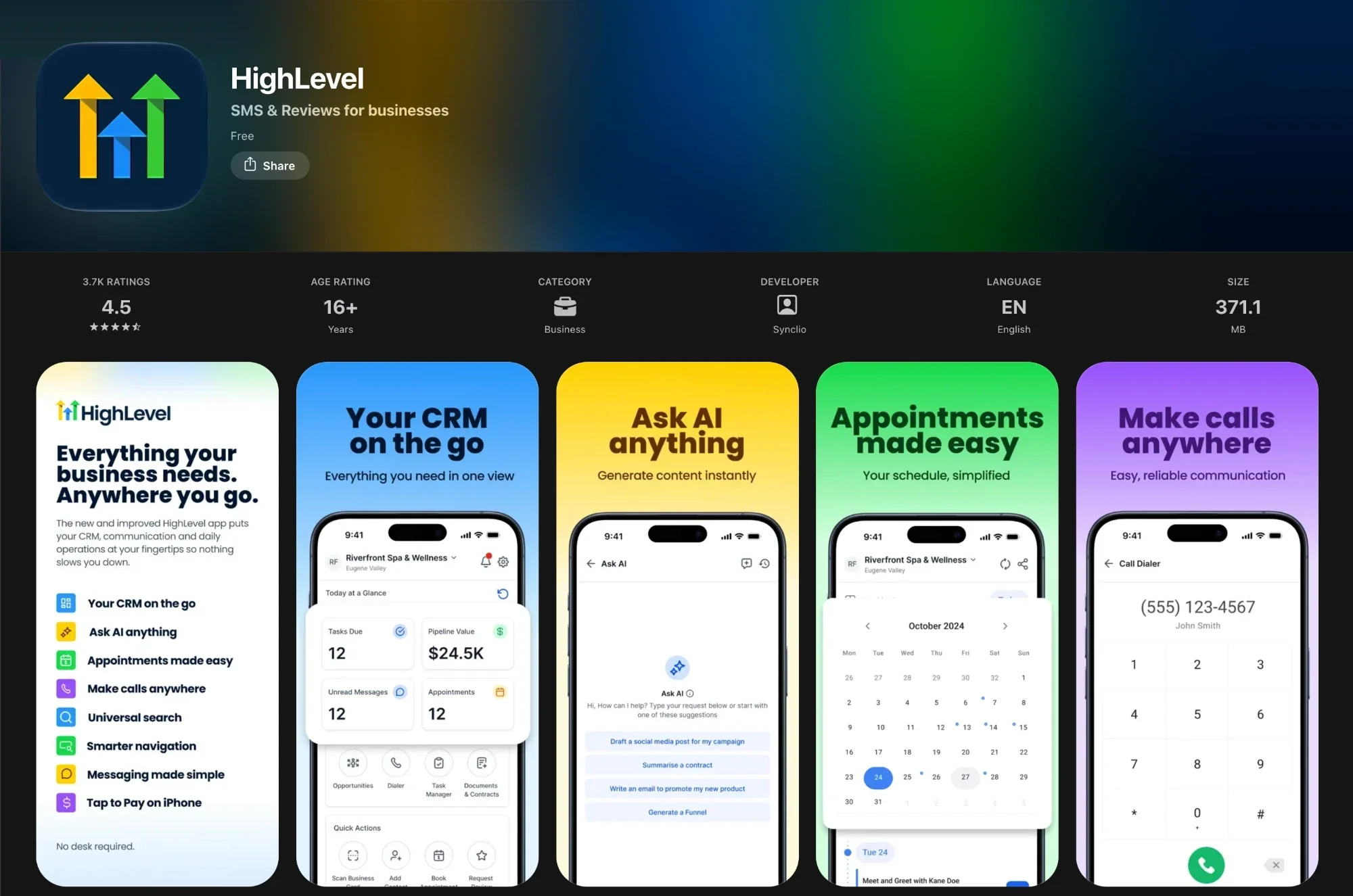
Keep two needs apart before you spend money here. Your team getting mobile access to the CRM is free with the standard app. Publishing your own branded app for clients is the $497 a month add-on. Most agencies need the first one long before the second.
Is the GoHighLevel website builder any good?
For lead generation, yes. The GoHighLevel website builder makes pages, funnels and forms that feed the CRM directly, so a visitor becomes a contact, an opportunity and a workflow without any integration to maintain. HighLevel's Funnels & Websites AI can also draft a page from a prompt, one page at a time, and suggest SEO titles and descriptions you'll still want to edit by hand.
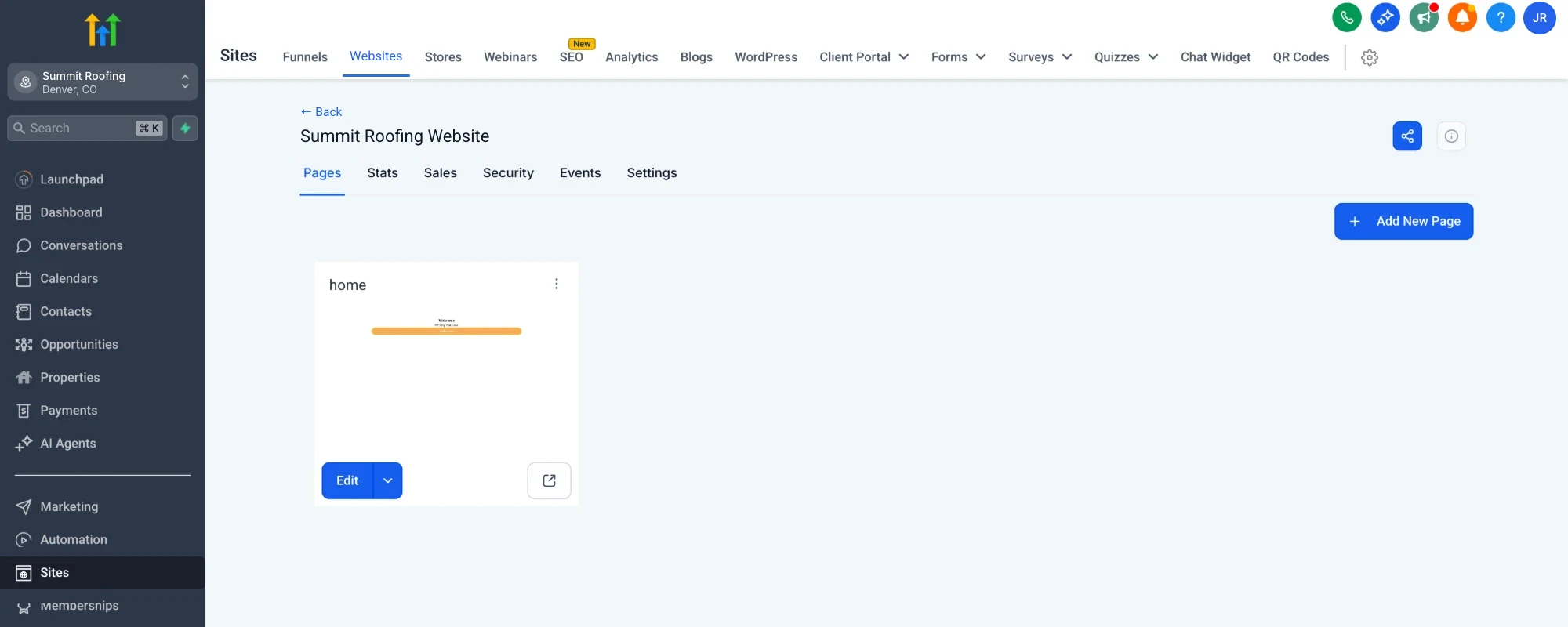
Where it's weaker: big content sites, complex e-commerce, and heavily custom designs. If organic search is a major channel, or your site is the product, a dedicated CMS gives you more control. The fair question isn't “can it build a website?” (it can) but whether the CRM connection matters more than specialist web features for that project.
Is GoHighLevel easy to use?
Honestly, not at first. Setting it up is closer to designing a business system than installing an app. Reviews say the same: HighLevel holds 4.2 out of 5 on Capterra from 89 reviews, but only 3.7 for ease of use and 3.7 for customer service. On G2 it sits around 4.6. The pattern across both is consistent: people love the breadth and the automation, and they warn about the learning curve.
The setup order that saves the most pain:
- List where your leads come from.
- Build one clean pipeline with stages your team actually understands.
- Decide who owns a new lead.
- Connect one calendar.
- Build the first-response workflow and test it on yourself: text, email and call.
- Only then add dashboards, AI, reviews, courses or SaaS Mode.
A CRM can look perfect in a demo and still fail in real life if nobody knows who owns a lead or what happens next. Get one lead journey working end to end before touching the rest.
GoHighLevel pros and cons
| Pros | Cons |
|---|---|
| ✓ Replaces several tools with one connected system | ✕ Steeper learning curve than a simple CRM |
| ✓ Sub-accounts and snapshots make agency work repeatable | ✕ So many features it can feel busy |
| ✓ Unlimited contacts and users on every standard plan | ✕ Usage and add-ons need their own budget |
| ✓ Powerful workflow automation | ✕ A badly built workflow annoys leads at scale |
| ✓ White label and SaaS Mode for agencies | ✕ Branded mobile app is a $497/month extra |
| ✓ Forms, funnels, calendars and CRM share one record | ✕ Website builder won't replace a specialist CMS |
GoHighLevel and Facebook lead ads
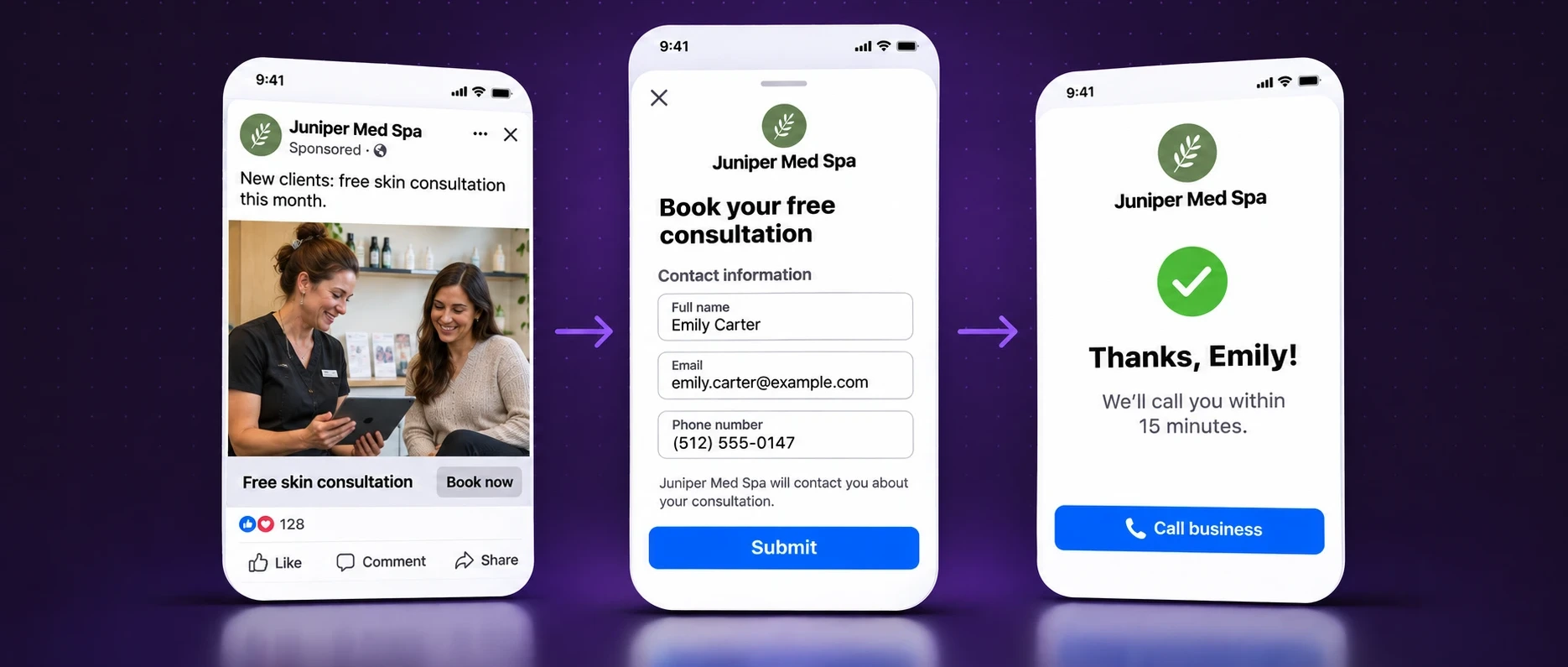
This is where most of our customers meet HighLevel. A paid lead is only worth something if it reaches a real follow-up process fast, and HighLevel is built for exactly that: once the lead is in, it gets an owner, an opportunity, an instant text and a booking link without anyone lifting a finger.
There are two ways to get Facebook and Instagram leads into GoHighLevel. Each sub-account has HighLevel's own Facebook lead form integration, which is free and works well when one person manages one Page. Or you use a lead delivery tool like LeadSender, which sends each lead in seconds, maps it to your custom fields and tags, and can send the same lead to Email, SMS or a Google Sheet at the same time. We compare both, step by step, in our guide to sending Facebook leads to GoHighLevel.
If your real problem is narrower, say leads sitting in Meta's Leads Center until someone remembers to check, rebuilding your whole stack in HighLevel is a big fix for a small gap. Sending each lead straight to the CRM, inbox or spreadsheet you already use often solves it in an afternoon.
GoHighLevel vs other tools
| Tool | Best at | Where HighLevel wins | Where the other tool wins |
|---|---|---|---|
| HubSpot | CRM and a broad sales and marketing suite | Agency pricing, sub-accounts, white label | Polish, reporting depth, a huge ecosystem |
| ClickFunnels | Funnels and sales pages | CRM, automation and client management included | Simpler if funnels are all you build |
| ActiveCampaign | Email marketing automation | SMS, calling, pages, calendars, agency layer | Deeper email specialisation |
| Calendly | Scheduling | Bookings feed the CRM and workflows directly | A cleaner booking experience on its own |
| LeadSender | Getting Meta leads to the right place instantly | A full CRM and sales system | Much lighter when you just need leads delivered to tools you already use |
Weighing HubSpot instead? Our guide to sending Facebook leads to HubSpot shows how lead ads work there, including HubSpot's own lead syncing.
Is GoHighLevel worth it in 2027?
For the right buyer, yes. It's easiest to justify when it replaces several paid tools and you'll actually use the connections between them.
| You are | Verdict | Why |
|---|---|---|
| A marketing agency with several clients | Strong yes | Sub-accounts, snapshots and white label are exactly what you need |
| A local service business with steady leads | Usually yes | CRM, booking and follow-up in one replaces several tools |
| An agency that wants to resell software | Yes, on Agency Pro | SaaS Mode and markup rebilling are built for it |
| A solo consultant using email and a calendar | Maybe | Possibly more system than you'll use |
| A content-heavy publisher | Mixed | A specialist CMS will serve SEO better |
| A large e-commerce store | Usually not | Dedicated e-commerce platforms go much deeper |
Our take: think of GoHighLevel as an operating system for agencies and lead-driven businesses, not just a CRM. You pay for it in setup time and a usage budget. You get it back in tools you can cancel and leads that never get forgotten. If you'll use the pipelines, workflows, calendars and sub-accounts, it's excellent value. If you'd only use one corner of it, buying the tool with the most checkmarks is the wrong call.
GoHighLevel FAQs
What is GoHighLevel?
GoHighLevel, now branded simply HighLevel, is an all-in-one CRM and marketing platform built mainly for agencies. It puts contacts, pipelines, email and SMS, calling, calendars, funnels, websites, reviews, payments and automation in one system, with separate sub-accounts for each client.
How much does GoHighLevel cost?
Starter is $97 a month, Unlimited is $297 and Agency Pro is $497. Paying yearly costs $970, $2,970 and $4,970. Enterprise is priced on request. Phone, SMS, email and AI usage are billed on top, and some features are paid add-ons.
Does GoHighLevel have a free plan or free trial?
There's no free plan. HighLevel offers a 14-day free trial on any plan, and billing starts automatically when the trial ends unless you cancel.
What's the difference between Starter and Unlimited?
Starter allows three sub-accounts. Unlimited removes that limit and adds basic API access and the option to rebill phone and email usage to clients at cost. If you manage more than three clients, Unlimited is the plan.
What do you get with Agency Pro?
Agency Pro adds SaaS Mode, so you can sell HighLevel to clients as your own software, plus automated sub-account creation, rebilling with your own markup, user and agent reporting and advanced API access.
Is GoHighLevel a CRM?
Yes. It has contacts, opportunities, multiple sales pipelines, a shared inbox, tasks and reporting. It also goes well beyond a CRM, into funnels, websites, calendars, payments and reputation management.
Does GoHighLevel have a mobile app?
Yes. The free HighLevel app (with an unbranded twin called LeadConnector for clients) lets you reply to conversations, call and text leads, check appointments and move opportunities from your phone. A white label version under your own brand is a $497 a month add-on.
How much is GoHighLevel white label?
Branding the web app with your own domain and logo is part of the platform. A white label mobile app in the app stores is a separate $497 a month add-on, and the Branded Client Portal App is $49 a month per sub-account.
Are there hidden fees?
Not hidden, but easy to underestimate. HighLevel's pricing page lists usage charges for phone, SMS, email and AI, plus optional add-ons such as AI Employee, dedicated email IPs and HIPAA compliance. Budget them separately from the plan price.
Is GoHighLevel good for small businesses?
It can be, if leads come in regularly and you'll use automated follow-up, booking and pipelines. If you only need a contact list or a newsletter tool, it's more system than you need.
Can GoHighLevel replace HubSpot?
For many agencies and small service businesses, yes, mostly on cost and the sub-account model. For larger sales teams that need deep reporting and HubSpot's wider ecosystem, HubSpot is usually the better fit.
Can GoHighLevel replace ClickFunnels?
For most funnel needs, yes, and it adds the CRM, calendars and follow-up behind the funnel. Teams that only build funnels sometimes still prefer a dedicated funnel tool.
Can GoHighLevel receive Facebook lead ads?
Yes. HighLevel has its own Facebook and Instagram lead form integration in each sub-account, and lead delivery tools such as LeadSender can send leads into it too. Once a lead is in, workflows handle routing, follow-up and booking.
What is the official GoHighLevel website?
It's gohighlevel.com. The company now goes by HighLevel, but the website, the app and most search results still use GoHighLevel.
Already running Facebook lead ads?
Whether you move to GoHighLevel or keep the CRM you have, the first job is the same: every lead has to reach your team the moment it's submitted. LeadSender sends Facebook and Instagram leads to GoHighLevel, HubSpot, Email, SMS, Google Sheets and more within seconds, with no Zapier in between. See the Facebook Lead Ads & GoHighLevel integration, or start a free trial and connect your first form in a few minutes.